Life as it ain't

"I'm not really from outer space. I'm just mentally divergent."

“It’s déjà vu all over again.”

Posted by Ronak M Soni on December 3, 2009

Cover of Diary of a Bad Year by J. M. Coetzee

Click to look inside

The primary joy of reading J. M. Coetzee is his appeal to the subvocaliser within me. To subvocalise is to read by saying it aloud in your head, and I invariably do it in voices. One joy of Coetzee is how effectively he varies his narrator’s voice. The other, principal, joy is the use of a voice which is used by a lot of younger writers, but which I feel only he has mastered completely; I mean a slow voice, where the speaker is dragging out his words without actually drawling, not because of the accent but because of the meticulous way he thinks. This voice has a sort of coldness coupled with clinicality. I’m in no way saying he originated it; I can find an example from around the time he was born: ‘The Love Song of J. Alfred Prufrock’ by T. S. Eliot. A lot of Eliot’s poetry has this voice, but this one is my favourite. When I first read his Waiting for the Barbarians in June ’08, this voice touched a deep, deep chord with me. I widely tout this book as the book which catapulted me into the world of serious literature. True, I had been heading there for a while, but this was the last straw.

One of the ideas behind Coetzee’s 2007 book Diary of a Bad Year is an examination of this voice when the writer’s powers are declining. It has, as a story, the writer Juan C. who wants to write a contribution to a German book called Strong Opinions. He sees a young, ethereal beauty Anya and asks her to be his typist; his motor control is going, and all he can do is scribble and speak into a dictaphone. She’s living with an older man called Alan, who acts as a foil to JC.

JC, like Coetzee, was born and brought up in South Africa and has just recently moved into Australia. He, in fact, has also written a book called Waiting for the Barbarians. So, the question arises: is JC in fact JMC? I don’t think so, principally because Coetzee’s powers are not failing. That, however, is nothing more than a brilliant dodge; it ignores the real question of whether the opinions are Coetzee’s. Again, I think no, and it’s due to the last essay in the book, coupled with the fact that Coetzee is a significantly more intelligent essayist than JC.

Each page of the book is divided into three parts. The top is JC’s contribution to the book, the middle is JC’s narration of his relationship with Anya, and the bottom (which first appears only at page twenty-five) is Anya’s narration of her relationships with JC and Alan, not to mention Alan’s relationship with JC. This results in us reading first a bit of an essay, then a bit of JC’s narration, then a bit of Anya’s, then some more of that essay, and so on. Coetzee, of course, often takes the opportunity to break a bit in the page mid-sentence. This structure plays with us in mysterious, as well as not so mysterious, ways, but to mention a couple of them, I will have to describe the characters for a bit.

JC is an old novelist who used to think of himself as a novelist who taught to fill his pockets, but is now thought of as “a pedant who dabbled in writing novels”. Through the course of the book, it becomes clearer and clearer that this one’s more of a poet than an essayist. His first few essays – which are so short that they rarely, if ever, have proper conclusions – make plausible points, but don’t argue them out too well. He just states them as fact. Of course, this is a problem later when he’s just plain wrong. When his essays really shine is when they speak of literature. And then there are times when he completely takes of the mask of the essay:

Someone should put together a ballet under the title Guantanamo, Guantanamo! A corps of prisoners, their ankles shackled together, thick felt mittens on their hands, muffs over their ears, black hoods over their heads, do the dances of the persecuted and the desperate. Around them, guards in olive green uniforms prance with demonic energy and glee, cattle prods and billy-clubs at the ready. They touch the prisoners with the prods and the prisoners leap; they wrestle prisoners to the ground and shove the clubs up their anuses and the prisoners go into spasms. In a corner, a man on stilts in a Donald Rumsfeld mask alternately writes at his lectern and dances ecstatic little jigs.
One day it will be done, though not by me. It may even be a hit in London and Berlin and New York. It will have absolutely no effect on the people it targets, who could not care what ballet audiences think of them.

And there are times when his poetry comes through in his essays, despite his efforts to suppress them, like the title, which actually makes some sort of sense in context. But, down below, in his diary, we see the cracks showing in his writing. At one point,

Are you new? I said, meaning was she knew to Sydenham Towers, though other meanings were possible too, Are you new on this earth? for example.

The real Coetzee often takes a question and does this sort of thing to it, but nitpicking of this scale is nothing more than a parody, or – since JC’s powers are failing – a tragedy. The first time I read this sentence, in November last year (this is the second time I’m reading this book), I thought JC was surely an overgrown kid. Later, the idea that he’s just a poet becomes stronger, when in the ‘Second Diary’ (Coetzee’s book is divided into ‘Strong Opinions’, 12 September 2005 to 31 May 2006 and ‘Second Diary’, undated), after he’s done with his strong opinions, he starts writing what Anya calls his ‘soft opinions’, where we see a sharp increase in plain quality, not to mention his near-absence in the middle bit which is now filled with things Anya are saying to him or just plain nothing; I think the idea here is that as long as he was writing his pure essays, we need his real voice, but later we don’t, because its already there above.

Anya is a beautiful Filipina, whose first appearance elicits this response in JC’s diary (note the substandard writing):

Startling because the last thing I was expecting was such an apparition; also because the red shift she wore was so startling in its brevity.

Surprisingly, she’s actually pretty intelligent, though not concerned enough to be an ‘intellectual’. I’m surprised because if you’re writing about the relationship between an intellectual and a commoner, it’s rather common to make the commoner a stubborn, though streetwise, ox. Notice, for example, the insight and sensitivity to the sound of words in her description of her relationship with JC:

At first I was supposed to be his segretaria, his secret aria, his scary fairy, in fact not even that, just his typist, his tipitista, his clackadackia.

Later, we will see bits from her that sound like they’ve come from JC (this last quote, unlike the ones I’m referring to, is rather female in its composition). She is, all in all, a rather well-rounded character. So well-rounded, in fact, that I think it’s a plausible interpretation that the book is about her.

Alan, as I’ve already said, is a foil to JC, and, like the best foils, is actually very similar in a fundamental way to him; JC is a socialistic anarchistic dreamer whereas he is a yuppie realist, but each is about as stubborn as the other. Anya is stuck in between these two. Both these characters are equally caricatured, and Anya is the well-rounded middle ground.

I realise I promised a mention of a couple of tricks the structure plays with us, but it turns out I ended up mentioning them above, like the last couple of sentences in my description of JC. Well, let me tell you that in the Second Diary, when I said that the middle part is taken up by Anya talking to JC, there’s a memorable sequence where the page is actually JC’s essay | Anya | Alan. On the whole, however, this structure has an effect of rushing the proceedings along. We read faster because we have two threads hanging at any one point in time.

I personally think Diary of a Bad Year is Coetzee’s most interesting book of the ones that I’ve read (in the order of my reading, Waiting for the Barbarians, Dusklands, Diary of a Bad Year, Life & Times of Michael K, Disgrace, In the Heart of the Country), but not his best. Well, just not his most effective; there’s always the question of how effective Coetzee wants it to be. After all, in keeping with the fact that the essays have barely any conclusion, JC doesn’t sign off so much as is cut-off. Anya does sign off. Anya has the time to finish with the book, but old JC doesn’t: it’s like life. And, after all, how effective is life as a book?

Posted in Book reviews, Books, Coetzee, J. M. | Tagged: , , , , | 4 Comments »

Dev.D: “I can make your sorrows go away in a moment.”"Fuck you.”"That too.”

Posted by Ronak M Soni on November 26, 2009

Title card

There’s a moment in Dev.D when you suddenly realise what the background song is saying, and how damned relevant it is. What am I saying? There’s one every ten minutes. The movie was directed by Anurag Kashyap, one of the new wave of Indian ‘independent’ directors. These guys, they aren’t really independent in the American sense of financial independence, bt in a sense of artistic independence. They are all involved in some big budget studio-produced movie now, but they don’t make studio movies.

Each one has a different style. For example, there’s Navdeep Singh who made a masterful noir set in the Indian rural areas called Manorama – Six Feet Under, which was a copy of Chinatown (mainly in story; what I’ve seen of the older movie is rather different from the newer one). Doesn’t sound very good, I know but he’s my favourite of this wave (I’m not comparing to the French and Mexican new waves; there’s some way to go before that), because he showed how well traditional noir adapts itself to Hindi, making use of the fact that Hindi speakers speaking Hindi have a certain frankness in their sound and look. Then, there’s Dibakar Bannerjee, a sort of Indian Jason Reitman, who makes light-spirited but serious movies(Khosla ka Ghosla, meaning Khosla’s Nest, and Oye Lucky! Lucky Oye!). There’s Vishal Bhardwaj, who specialises in Shakespeare flicks (Omkara from Othelloa review – and Maqbool from Mac… you can guess; both are character’s names, like the originals), dark children’s movies (Makdee meaning Spider – a review – and The Blue Umbrella, possibly his best movie, a review) and a great-looking tribute to Tarantino(Kaminey, meaning Scoundrels; a review), all of which are, more than anything else, visual treats.

And then there’s Anurag Kashyap, the case in point. He started off with a crime drama called Paanch (Five) that the censor board didn’t allow. Then, there was a sensitive look at the terrorists who participated in the 1993 Bombay bombings called Black Friday, which I remember watching and being affected by but nothing more. Then, he made the Lynch-ish No Smoking which had similarities to the Stephen King story ‘Quitters Inc.’ but was not based on it (Kashyap added in stuff from the other end to make it look more like it was when he realised how similar his script was to the story). It was a parable about freedom, which was actually much more linear and coherent than a Lynch movie is (I talk about Lynch only from reputation). Then, there was Dev.D this year, which is the case in point but coming to which I’ll delay for a while. Then, there was Gulaal (it’s the name of a red powder used to colour the skin), which was political… something. It was structured like a play, not in terms of its scenes and setting but in terms of its characters, the way they faced off against each other and the way tehere was a Shakespearan jester chock-full of wisdom… you know what I’m talking about. This last one or Black Friday would be my idea of a good introduction to Kashyap.

My favourite thing about Anurag Kashyap is the way he seamlessly combines madcap elements of popular Bollywood with the gritty realism and silence of ’70s Hollywood with the stream-of-consciousness imagery of Godard (I think) and the like. As I’ve already said, there’s a moment every ten minutes in Dev.D when you suddenly realise what exactly the music is saying. And there’s a lot of it, I tell you: it was a big thing when it came out that it had eighteen songs, none of which, however, play full length. I don’t think anyone counted the excerpts of songs from other movies.

Dev.D is based on Saratchandra’s classic Bengali novel Devdas, which there have been either twelve or twenty-one screen adaptation of. In fact, I as of now have a disk of the classic nineteen-fifties Bimal Roy version which I’ll get down to next week. The original novel is the story of Devdas, a Bengali landlord’s son who is in love with the manager’s daughter Paro (short form for Parvati). His parents force them not to marry because she is of a lower caste, and he loses it, drowning in his unrequitable love, and drink. During this period, he meets a dancer Chanda (short for Chandramukhi) – during that time, that was a disreputable profession – and her ringmaster Chunni. I’m slightly hazy on what happens now, but I know it ends with Devdas dying.

Dev.D is the story of Devendra Singh Dhillon (Abhay Deol, nephew of legendary Dharmendra), son of a sugar mill owner in Punjab. Paro, yet again, is the manager’s daughter. He comes back from London, where he went to study. Then, he and Paro (beautiful, beautiful Punjabi actress Mahie Gill) have a series of sexual encounters which just refuse to end up in sex. At this time, Dev’s brother Dhwij is getting married. Here, Dev meets Rasika who lures him out for a drive. They start making out but Dev has to stop, because she’s not Paro. He comes back, and almost immediately is told by a worker who loves Paro that she sleeps around with anyone who wants. So, Dev leaves her, and overhears a confession of the lie during the marriage. Soon, Paro is getting married to someone else, and there’s a song when she is getting married (two madcap Bollywood elements right there: a song, and the fact that an adult-material song is playing at an Indian marriage). Here’s a video of the song, called ‘Emosanal Attyachar’ (Emotional Torture). The drinking man is Dev, and the woman madly dancing in a red dress is Paro. Sorry, non-Hindi speakers, I couldn’t find a version with subtitles, but watch it for the music anyway.

Anyway, this guy starts going downhill, meets hooker Chanda (French-descended theatre actress Kalki Koechlin), who has her own back-story, and… well, I won’t tell you what happens then, but it’s different from the original.

Title card for Paro segment

Paro's theme

Mahie Gills face

Paro

The movie is divided into three segments: Paro, Chanda and Dev.D. The first is about Paro, which I’ve described above. The old Paro was the perfect woman by early twentieth century standards, respectable as they get, and effusively in love with Devdas. The new one is the perfect woman by today’s standards; sexually alive, madly in love, and the real wearer of the pants in the pair who makes the other think he is. At one time, after many unsuccessful make-outs, Dev asks her to do something, anything. She says, “Why? You’re throbbing?”(pardon me, I’m not a very good translator, so I just do literal) “Yes.” “Good!” And she runs away. In normal playfulness, it’s the guy who’s complacent. Also, there’s Abhay Deol’s body language. So, it ands right after the song I posted up there.

Chandas theme

Chanda theme

Chandas gace

Her face

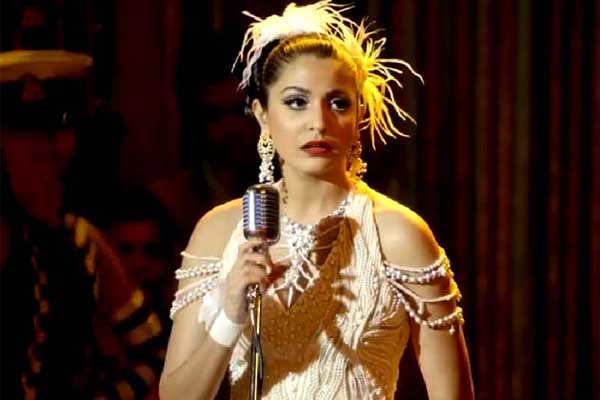
The second part, ‘Chanda’, is about the back-story of Chanda. She was a half-French half-Indian twelfth-grader in New Delhi called Leni who loved Hindi movies when her lover publicised a video of her giving him oral sex. Her father kills himself, she’s generally feeling quite unsupported by her family, her paternal grandmother accuses hr of killing her father… and she runs away. Back in Delhi, she’s picked up by a brothel owned by Chunni (well-played by Dibyendu Bhattacharya, who wasn’t given too much to do anyway), who allows her to finsh her education as long as she has real and phone sex and stars in pornographic movies. She has to choose herself a hooker name, and she chooses Chanda while watching the great-looking 2001 Sanjay Leela Bhansali Devdas movie. One day, a semi-conscious man is hauled into her room, and he, while still in the daze, murmurs “Paro”.

Dev's theme

Dev's theme

Dev's face

Dev's face

The third segment ‘Dev.D’ is about Dev’s further decline, relationship with Chanda (the title is an exchange between Chanda and Dev), and the eventual (eventual) end. This is a man who only feels in a flat, undistinguished way. His elation is reserved, his sadness is angry, his depression is an emptyness rather than a negativity. It is this emotional rut that he gets out of in the movie.

The two best things about this movie were the colours and the acting. You see the screenshots of the faces? That’s only part of the variation of the colour palette in the movie. And the acting: all three actors have amazingly honest faces, and all they need to do to draw us in is feel what the character is feeling.

Okay, now I’ll stop. The post is already way too long. I’ll just say that this is in true bollywood style as given by this quote from Ebert:

Bollywood musicals are the Swiss Army Knives of the cinema, with a tool for every job: comedy, drama, song and dance, farce, pathos, adventure, great scenery, improbably handsome heroes, teeth-gnashing villains, marriage-obsessed mothers and their tragically unmarried daughters, who are invariably ethereal beauties.

It is hilariously funny, a great musical, has some though not many unplumbed depths, has some gritty reality, and has Arronofsky-sequences. What more can we ask? Well, it’s not perfect. It has a substantial number of sticking-out-like-a-sore-thumb shots, and it often glosses over real sadness, perhaps in an attempt to make us feel Dev’s flatness of emotion but which results in a sort of apathy.

The Twilight Players, three singers who keep on randomly turning up in the Delhi segments

The Twilight Players, three singers who keep on randomly turning up in the Delhi segments

Posted in Kashyap, Anurag, Movie Reviews, Movies, Uncategorized | Tagged: , , , , , , , , , , | 6 Comments »

Too good of a much thing

Posted by Ronak M Soni on November 23, 2009

All constructive criticism/clicking on thumbs will be appreciated.

Why
Is it so maniacally important to you
That I exist?

Don’t you know
Shouldn’t you know –
That humour lies in the breaking of expectations?

Posted in My Own, Poetry | Tagged: , | 10 Comments »

Avaze Gonjeshk-ha: a Face and a Camera

Posted by Ronak M Soni on November 19, 2009

Movie PosterThere’s something batshit insane about Majid Majidi’s The Song of Sparrows (my first experience of Majidi). Don’t get me wrong; I love the movie. It is one of the most down-to-earth movies I’ve ever seen, but it has a sort of manic energy you don’t see in American, or Indian or British, cinema. Personally, I hadn’t seen anything like this before. While both (the best of) Bollywood and Kurosawa have a manic energy, there’s nothing else quite like this.

Most of the magic in this movie comes from the lead actor Mohammed Amir Naji and the camerawork. The former plays a simple, homely man called Karim who has a job on an Ostrich farm, loves his wife non-platonically and has three kids who he loves and scolds. All of that, however, is beside the point. He is basically an oversized kid who understands the concepts of responsibility and sex. He also has hair that magically reflects his mental state. Except that it’s not magical: every time, you can think of a perfectly good naturalistic reason for the state of his hair. His eldest daughter is deaf, and uses a hearing aid, which gets lost in a sludge-infested water storage that has been blocked for a long time when she is helping her brother (the middle kid) clean it up, so that he and his friends can start a goldfish-farm in it. He is an attractive man whose eyes are a match for those of the master of eye-expression – Toshiro Mifune – himself with a mysteriously endearing bulbous hooked nose. The number of shots of his face probably outnumbers all the other shots in the movie (I watched this movie last night, so you can make of this sentence what I will: that’s what stays on in my memory).

Naji's face

The face

The camerawork: this is one of those rare movies (only other I can remember is Three Colours: Blue) where you don’t feel the weight of the camera in the moments when you are looking at the camerawork. It is so simple – so natural, even – that… it looks it. I don’t know enough about movies and camerawork to be able to say any more. There is, in general, an alteration between close shots and beautiful long shots, used often to trick us and manipulate our feelings, but in a way that they aren’t manipulated to non-existence. Watch out, especially, for his last-ditch effort for finding the lost Ostrich.

Wait right here: I said “Most of the magic in this movie comes from the lead actor Mohammed Amir Naji and the camerawork.” This, the fact that they overshadow the story, is certainly the biggest compliment I’ve given Majidi and Naji. There’s an abandoned, blocked water storage outside his house, which is the one his daughter loses her hearing aid in. He, his son and his son’s friends find it, but it doesn’t work anymore. He finds out he has to go to the city, Tehran, to get it repaired or replaced. He goes to work and asks the supervisor – called Ramezan – for an advance on his salary and is refused. He lets an Ostrich escape, and goes around on his motorbike looking for it. He can’t find it, and is fired. He goes to the city, finds out he needs to either wait for four or five months (the girl’s exams are the next month) or buy it on the open market for an astronomical price. He’s sitting on the curb, on his motorbike, when he unwittingly becomes a bike-cab-driver. This is just the set-up. The really magical part of the story are the complications – Ramezan’s leaving for a pilgrimage, the increasing hedonism, his son getting the storage clean, the accident that happens due to his jealousy that makes him an invalid, the visit to the city after the kids buy the goldfish – and the end. I would love to reveal one part of the end, but since enjoyment of movie is more important than enjoyment of review, I won’t.

I should put in a word for the community in which the movie is set. It is the close-knit type in which everyone helps every one. I didn’t make it sound very charming, but I assure you it very much is.

And here’s the best part: I didn’t enjoy this nearly as much as I could have. I watched it on the Indian channel UTV World Movies which, despite being a blessing for people like me seeking exposure to undubbed world cinema, has a constant static in the background, a fact which makes every movie devoid of silence (further commendment for the channel: I watched it from beginning to end without any breaks).

Posted in Majidi, Majid, Movie Reviews, Movies | Tagged: , , , , , , | 2 Comments »

I love being told why I’m watching the movie

Posted by Ronak M Soni on November 15, 2009

Director Richard Linklater and cinematographer Lee Daniel may have just realised one of the fundamental truths of the camera: put a man and a woman in a cramped space together for enough time, and soon the subtlest mannerisms are going to become some of the most outright and obvious expressions of their feelings.

I am talking about their two movies Before Sunrise and Before Sunset, recommended to me in this post, by Literary Dreamer. The basic story is that Jesse (Ethan Hawke) and Celine (Julie Delpy) meet on a train and immediately hit it off. Jesse has to get off at Vienna to catch a flight to the US the next morning, so he convinces – using a virtuoso argument involving time travel and a theme, of regrets about life-changing decisions, that is going to resonate through both movies – her to get off with him and catch a later train to her native Paris. Before Sunrise is about – spans – the day and night they spend roaming around Vienna (it is a part of his original argument that he’ll be roaming around all night because he can’t afford a hotel). The next movie is about what happens nine years later.

In Vienna, the size of the spaces they occupy for a significant amounts of time grows steadily larger, from a two-seat on a tram to a music trial room to a park. Which brings me to the fundamental truth. After a while of them sitting so close together that his removing his jacket provokes her to unconsciously withdraw physically, under the pretense of arranging her hair. And then there’s a wonderful little sequence where they go into a small room to listen to a record, and both of them… let me invoke Roger Ebert here (both of whose reviews I recommend for reading only after watching the movies, as he spoils them): “each one looks at the other, and then looks away, so as not to be caught. The way they do this – the timing, the slight embarrassment – is delicate and true to life.” For me, it transcended a sweet little scene to become an outright comedy, the type in which you laugh purely out of love. By the time we’re into parks and roofs and long shots, you can recognise each little mannerism from so far away that you find their movement more interesting than the scenic locations.

Screenshot with green-lighted bit in the background. I wasn't looking at the green

I wasn't looking at the green-lighted entrance

And, of course, there’s the dialogues. They discuss everything from what’s wrong with the world to… well, I don’t want to spoil, so I’ll just say why you are sitting and watching these two movies. And they are so good, so well-placed… Against my better judgement, here’s one from early in the second one (I, however, will abstain from identifying the souce of this dialogue):

Maybe what I’m saying is, the world might be evolving the way a person evolves. Right? Like, I mean, me for example. Am I getting worse? Am I improving? I don’t know. When I was younger, I was healthier, but I was, uh, wracked with insecurity, you know? Now I’m older and my problems are deeper, but I’m more equipped to handle them.

There is, however, one problem with the movies:  the ends sucked. First, I thought it was because I enjoyed the characters so much. However, on closer thought – taking into account the fact that there’s going to be a third one -, I decided that maybe they were supposed to. Though technically closure shouldn’t happen (these two movies with closures would be truly horrible), I think I felt that there could be some amount of closure to be found in that third movie. There was the early morning, before sunrise; then there was the day, before sunset; what about an account of that night, to finish things – and the twenty-four hours – off? If it comes to India, there’s one person who’s going to be there, first day, first show. Otherwise, as soon as he DVD is out.

For now, Waking Life.

Posted in Linklater, Richard, Movie Reviews, Movies | Tagged: , , , , , , | 22 Comments »

My First Reviews

Posted by Ronak M Soni on November 14, 2009

Today, entirely by accident, I found my IMDb review history. I realised that these two were the first two reviews I had ever written. Then, I realised that these two were the first symptoms of what would later develop into this blog. So, I’m posting them.

First, on the twentieth of August 2009, I posted a review of Sudhir Mishra’s brilliant Hazaaron Khwaishein Aisi (literally Thousands Such Wishes; sorry, I can’t come up with a better translation). Honestly, I need to watch it again and write some more about it. I should warn you that there is the general idea of a spoiler here, but I feel that you can enjoy the movie nevertheless.

A movie that raises many questions and answers them in an inevitably simple way

Have you ever watched a movie with one girl and two guys, one guy a stud and the other a nice guy at heart, and in which the girl tries to have a relationship with the stud and ends up realising that she should be with the nice guy?

I’m guessing, yes. Well, imagine a movie with a problem at its heart. The characters: one girl(Chitrangda Singh), two guys(Kay Kay Menon and Shiney Ahuja). The girl loves the man who tries to solve the problem(Kay Kay). The other man(Shiney) – who’s poorer – feels that those are all rich kids’ games. He is, at heart, a nice man, but a practical man. I won’t say any more, but you should have figured out by now what the title of this review means.

It isn’t, however, just about the characters. It’s also an insightful treatise on society. For example, very near the beginning, there is a scene where Kay Kay’s character realises the weight of tradition, an idea that comes back later in the film. The landlord’s son has raped a lower-caste woman and the untouchables are all up in arms, when the landlord gets a heart attack and is cured, by the untouchables.

But what really struck me about the movie was that the characters spoke English like…well, human beings. In most Hindi movies nowadays the characters’ English accents makes me cringe, bringing up words in my mind that I won’t reproduce here.

So, on the whole, a very very good movie with a lot of brilliant scenes in chronological order that don’t feel like part of the story – though they are -, as being part of an overarching story would ruin them.

The second, on the twenty-eighth of August 2009, was of Iron Man. This one, I feel, is a complete review.

A bloody comedy!

‘Iron man’ is the first superhero movie that is mostly a comedy. Sure, there are lots of fights and all, but it’s all about the dialogues and the characters – there were, I think four action sequences in the whole movie.

The movie, refreshingly, doesn’t take itself too seriously: Stark stops and explains himself a sum total of one time, for about two sentences. And it makes sense. You see the weapons you have made in the hands of the terrorists, you don’t sit back and philosophise, you bam.

It’s as simple as that. A man who thinks he’s helping the cause of peace finds out he isn’t and tries to rectify it.

Yes, the other characters. Well, they are never established. Need I give Favreau a bigger compliment?

Now that I think of it, I wrote a few short reviews of books before these, on World Literature Forum. Here’s the first one, posted on the thirtieth of April 2009, of Vikram Chandra’s Red Earth and Pouring Rain (original thread here):

The only accurate word I can think of to describe this book is big. Not in terms of length, not even in terms of scope and imagination but in terms of the realistic universe Chandra creates. Here, by realistic, I mean rooted in reality: it could very well have happened and we don’t know about it because we just didn’t see it. Every new element of fantasy he brings in first looks like it is only there to satisfy Chandra’s sense of humour. Then, we eventually get to see the self-wrapped ness, so to say, of the universe he’s created and how every element fits in.
I absolutely love the way he layers story-telling upon story-telling to create a web of stories within stories(most of the book is a monkey telling a story about a man telling a story about someone telling him about the monkey’s previous life). This circle of stories also adds to the impression of bigness that you get.
His writing is remarkably accurate, modelling most of the narrative style according to the style of the narrator at that point, which tops off in the war scenes where there are sentences spanning pages; this is how people talk in that sort of epic excitement.

The only problem with the book that I could find was that it was too verbose in some parts (that is, more verbose than the style of the moment demanded).

PS: I’m sorry I could not give specific examples here, but I read the novel almost three and a half months ago(couldn’t write the article sooner because of a series of exams).

Posted in Book reviews, Books, Chandra, Vikram, Favreau, Jon, Mishra, Sudhir, Movie Reviews, Movies | Tagged: , , , , , , , , , , , , | 5 Comments »

A Story told in Pictures

Posted by Ronak M Soni on November 11, 2009

I watched Nina Paley’s Sita Sings the Blues around an hour ago, and I thought of a great way to write about this film: just show lots of screenshots, and add a minimum amount of commenting from below. Ought to be enough, right? Obviously, I refuse to do that because the thing I liked best about it was being continuously surprised visually. In fact, I’m going to go the exact opposite way, by showing only one or two screenshots.

The closest parallel I can think of to this movie is Julie Taymor’s Across the Universe, which used Beatles songs to talk about a love story. Sita Sings the Blues uses Annette Hanshaw’s Blues music to tell the Ramayana and Nina Paley’s ’similar’ – I’ll come back to this later – story . The two major differences between the two are that the latter is animated, and while the latter merely uses the music the former exists solely for it. The major difference I felt, however, was that, for me, the former worked as a movie. Don’t get me wrong, I very much enjoyed this movie. Never in its eighty or so minutes did I feel like looking away. It’s just that there were characters on the screen, and I didn’t feel anything of what they felt.

The importance of this fact, however, is rapidly dwindling with time. Why? Simple; because watching this movie was an experience that was worth not thinking much of it as a movie. Would I have been happier, more involved, if I cared for the storyline? Yes, very much. Do I hate this movie because I didn’t care for the people in it? Nah, I’m too young for that.

Before I go to the most important part of this review, let me talk about the ’similarities’ that Miss Paley found. They do exist; there’s no denying that. A warning, however, to people who have never read the Ramayana: the story is twisted almost completely out of shape. It’s like this, you see: people will see what they want to. (This is just a warning to a reader who hasn’t read the Ramayana, not a complaint against the movie.)

Now, after having not talked about the visual style of this movie for way too long, let me talk about it. Actually, I can’t. You see, its visual style is intrinsically connected to the storytelling style as well as the background score, so I’ll try and talk about all three together (though I probably won’t be able to). The movie has, basically, four distinct styles, which I will call modern-day, talking-myth, sita-singing-the-blues and free-for-all.

Modern-day is very rudimentary, really. It’s just meant to fill us up on Miss Paley’s life, and how she got the inspiration to make this movie. The most interesting thing about it is how the image keeps on shifting; unlike our normal expectation from cartoons, which is a naturalistic movement, this was just hastily hand-drawn, so that one frame is not the result of a naturalistic movement from the last but a very noticeable shift. I say it is hastily hand-drawn, but I have to point out that this shift dies down when called for, which is just a tribute to Miss Paley’s (all other ways to refer to her seem wrong) skills as an animator. So, why was it done this way? To provide some relief from the attack on our senses that is the rest of the movie, is my guess, and because the world the target audience is familiar with doesn’t need to be filled in. Anyway, here’s a screenshot from this style:

Screenshot in 'modern-day' style

Look at the subject line

There’s the talking-myth style which is used when the characters from the Ramayana are talking, in prose. It is a clever amalgamation of the Madhubani style of painting, Indian Shadow puppetry and more Mughal-influenced renditions, and these are just the ones I picked up. I congratulate Miss Paley in knowing more about Indian art forms than almost the whole of India. I refuse to show screenshots of this as it is so mindlessly inventive that can’t think of a suitably dull moment.

Then there’s the sita-sings-the-blues. This is what has received most attention, and, you know, it stars Annette Hanshaw, singing the blues. Now, this part really irked me; why is it that, no matter what, Sita looks happy? It is monstrously irritating.

Screenshot of 'sits-sings-the-blues' style

Give us this day our daily popcorn

Free-for-all, my favourite. This is the dullest bit I could think of.

Screenshot from 'free-for-all' style

Her beginning is where I end

Posted in Movie Reviews, Movies, Paley, Nina | Tagged: , , , , , | 6 Comments »

“In the pause the waves gathered on the rocks below, and then Subramaniam spoke.”

Posted by Ronak M Soni on November 9, 2009

Recently, for my English exam, as part of an essay about the parts of a story, I wrote that the exposition was the most orderable part of a story, as it can be anywhere, and everywhere. The example I gave then was Rabindranath Tagore’s lovely story ‘The Punishment’ in which bits of it are sprinkled all through the story. If I were asked now, I would give instead Vikram Chandra’s Love and Longing in Bombay (which is a collection of the things Subramaniam spoke) as the example, for it is a book in which the main part of the exposition is in the last story of five, a story which for that very reason is my favourite. The characters are of course introduced in the beginning, but all the important things are said (or, rather, implied) in that story. In keeping with Chandra, I will keep the really important part of my exposition of the book to the end too.

Each story in this collection is named after the Hindu (not Hindi) name for an emotion; Dharma, Shakti, Kama, Artha, Shanti. These names, they aren’t really for emotions (Dharma isn’t in any way an emotion); they are heavily nuanced concepts of human experience, and you’d better know that I have little idea of these nuances. They are part of that little but influential minority of the Hindu tradition that is written down. Actually, it’s only been written down comparatively recently, till then all the texts were known purely orally. Having said that, let me dive into a description of the stories, and some thoughts on them.

Dharma, in a gross over-simplification, means duty; rather an obligation to do something, and that something is pre-ordained, a function of your nature and that of your environment. In the beginning of ‘Dharma’, we are being narrated to by a young man who is feeling, and acting, a little disagreeable in a bar he has been taken to visit by one of his friends. This narrator will begin each story for us. Then, a man, a retired civil servant, named Subramaniam starts telling him a story, which begins like this (with the last sentence before this being the one in my title):

On the day that Major General Jago Antia turned fifty, his missing leg began to ache. He had been told by the doctors about phantom pain, but the leg had been gone for twenty years without a twinge, and so when he felt a twisting ache two inches below his plastic knee, he stumbled not out of agony but surprise. It was only a little stumble, but the officers who surrounded him turned away out of sympathy, because he was Jago Antia, and he never stumbled.

After this virtuoso display of character exposition, we see that this pain forces him to leave his job and go to his parent’s house in Bombay, where he finds what everyone around him is convinced is a ghost. It is in the first meeting with the ghost that I first saw one of the hallmarks of Chandra’s writing: his gift for cinematic images.

The white blaze of lightning swept across the lawn, throwing the filigreed ironwork of the railing sharply on the wall, across Jago Antia’s belly,

Seriously? Jago has a belly? You just don’t imagine a guy like that below his chest (just in case, I mean the sort of person who ‘never stumbles’), and Chandra uses an opportune moment to show us that this guy has a belly, not even a stomach but a belly. In plain English, that means he’s showing us that Jago, despite everything, is vulnerable.

Shakti is power. I don’t know any better way to say it. This one’s about a woman who’s trying to climb her way ‘up’ Bombay’s Malabar Hill (something similar to Beverly Hills). It jumped easily – I’ll come back to this later – from the glee of narrating great politics to love story and back without straining at my credulity. This was my second-favourite story, and says something really nice about the title, and shows us some more of those images, but there’s nothing more to talk about here.

Kama is desire, in the sense of lust. This is widely agreed upon to be the best, and I can see why; it is rather extraordinarily written, but that is mainly because Chandra chose an extraordinary subject. It begins with the narrator lamenting about heartbreak. Subramaniam tells him a story to relieve him. The story is about a Sikh policeman trying to cope with a newly-found loneliness. We learn that he is a dandy, and a vain man who wants everyone to love him, but is forced to keep this impulse hidden in the depths in service of his job. Now, his wife, who in college was attracted to him for exactly that reason, is leaving him. And he’s investigating a murder. Sounds somewhat obvious, but, as I’ve already said, it is extraordinarily written, and extraordinarily thought out (watch out especially for the explanation for his having to hide that aforementioned impulse ‘in service of his job’). Since I have to provide a quote to back this up, I choose to filch from this review:

In the rearview mirror, Sartaj could see Kshitij’s shoulder, the line of his jaw, and he thought, it’s always hard on the serious ones. They were always tragic with their earnestness and their belief in seriousness. He remembered two boys who were the grandsons of farmers in his grandfather’s village near Patiala. He recalled them vaguely from a summer visit to the village, remembered them in blue pants and ties. There had been a celebration of their results in the seventh class exams, and he had tried to talk to them about the test match that everyone was listening to but had found them boring and uninformed. After that he had never seen them again and had not thought of them for years until his father had mentioned them during a Sunday phone call. They had been caught by a BSF patrol as they came over the border in the dunes near Jaisalmer laden with grenades and ammunition. They had tried to fire back but had been neatly outflanked and machine-gunned. The papers had reported the death of two Grade-A terrorists and had reported their names and their affiliations. There had been a grainy black-and-white photograph of sprawled, bloodied figures with open mouths. Sartaj had never heard of their organization but had no doubt it was a very serious one.

In ‘Kama’, I began seeing something even more extraordinary; there were images that were being repeated, contrasted, used to make some sense of the scene in a way they never could have without that extra input of context. The filigreed ironwork, for example, is used as the background for a dubious confidence. There were many more, but I won’t mention them, in the interest of not spoiling the stories.

Artha is gain/wealth; I’m not completely sure which would be a closer translation. This, if you ask me, was the worst story of the five, despite a hilarious climax, because the end just wasn’t convincing. It, however, is brilliant in the fact that it takes up one more level of storytelling, with Subramaniam telling the narrator and his girlfriend Ayesha about a day in a train, when he was told a story, which itself was supposed to make a point, in the way Subramaniam’s stories do for the narrator.

And, finally, my favourite, ‘Shanti’. The word means peace, though I think but am not sure it is somewhat broader than the English word. For the first time in the book, our narrator (whose name is now revealed) meets Subramaniam outside the bar, and is taken home by him. This story is about a guy called Shiv who has just lost his brother and how he finds solace in a woman who has just lost her husband in the war Shanti, and exchanging stories with her.

All through the book, I had little bits of problem with the book, a phrase here and a comma there, but I’ll just – as a representative – point out one I found here:

Inside the door marked “Subramaniam” in brass letters, I bent to take off my shoes, and I could see the space was cool and large.

Is it just me, or does the togetherness of the last two clauses reminiscent of a hunchback? Sure, there are many ways for that to happen, but this is the first image you get, and it jars.

After that, it quickly gets better, because of Chandra’s amazing ability to modulate his voice. However big a mistake he made, I quickly forgot, because I really believed in the character who was talking at the time. Just to illustrate this, I urge you to read the quote from ‘Kama’ followed by this one:

And then she told him the story of the most evil man in the world. Shiv listened, and the words came to him through the burning of his blood and the din of his pulse. The shadows drifted in the room and then she was finished. Then Frankie came in and said the train was near, and they walked down the platform, and Shiv held her attaché case in his right hand, and walked slowly behind her. They stood on the platform until the train came, and when the train pulled away neither she nor Shiv waved or raised a hand.

Now, ‘Shanti’, Shanti and Shanti. Truly it is this story which sets for the whole book a context, and fittingly one which is probably fictional, fictional in all three universes; ours, Subramaniam’s, and his story’s. I’ve read that this book often communicates a love for storytelling. From my previous experience of Chandra (Red Earth and Pouring Rain, the narrative of a monkey telling the story of a man who’s narrating the story told to him by a woman who’s seeing the story of the monkey’s past life through a bit of water), I understand what is being talked about there. I won’t say much, but this story provides a context for the book in almost every way.

A context is given for the telling of stories by Subramaniam. A context is, simultaneously, given for the fact that these stories are in a book, a frame story at that. A context is, in fact, given for the act of storytelling itself, this one in almost the same way as in Red Earth and Pouring Rain. A context is, finally, given for Bombay, a context in itself for all this Love and Longing, a love and longing which this book made me, too, feel.

Posted in Book reviews, Books, Chandra, Vikram | Tagged: , , , , , , | 9 Comments »

The King of the Log

Posted by Ronak M Soni on November 3, 2009

Sorry that this is under poetry, but I like to think of this as a prose poem.

Yet again, all constructive criticism/clicking on thumbs will be appreciated.

I stopped. It had been a long run. Now came the hard part. I had woken up at five in the morning and gone for a ten kilometer run. Now, my eyelids drooped, the film of adhesive between my eyelids getting to work.
I heard the wet sand crunching under my shoes, the calls of early morning birds. The wind blowing my hair into my face, I stumbled over a root: my lids had drooped to below my irises.
The lovely, cool wind slipped under my t-shirt and raised every little hair, leaving with the sweat that stuck it to my body. I pulled my eyes open against the dark, magnetic pull.
The sleepy feel of debris under my eyes – that patched inoffensive film of it that called for sleep – weighed my head down, bent my back, buckled my knees, pushed me all the way down.
I got up, sweaty as well as dirty. Jolted awake, the tears came to my eyes, dissolving up the adhesive, the debris, blotting my sight. I rapidly blinked to clear my eyes. And smiled: we primates tend to rule.
For, in front of me, on a log, sat a monkey, his right knee next to his face, his forearm hanging off it, and his other hand feeding himself; for, in front of me, on a log, sat its king.

I stopped. It had been a long run. Now came the hard part. I had woken up at five in the morning and gone for a ten kilometer run. Now, my eyelids drooped, the film of adhesive between my eyelids getting to work.
I heard the wet sand crunching under my shoes, the calls of early morning birds. The wind blowing my hair into my face, I stumbledover a root: my lids had drooped to below my ires.
The lovely, cool wind slipped under my t-shirt and raised every little hair, leaving with the sweat that stuck each one to my body. I pulled my eyes open against the dark, magnetic pull.
The sleepy feel of debris under my eyes – that patched inoffensive film of it that called for sleep – weighed my head down, bent my back, buckled my knees, pushed me all the way down.
I got up, sweaty as well as dirty. Jolted awake, the tears came to my eyes, dissolving up the adhesive, the debris, blotting my sight. I rapidly blinked to clear my eyes. And smiled: us primates tend to rule.
For, in front of me, on a log, sat a monkey, his right knee next to his face, his forearm hanging off it, and his other hand feeding himself; for, in front of me, on his kingdom, sat the king of the log.

Posted in My Own, Poetry | Tagged: , , | 5 Comments »

A Philosophy of Mutability (or) what was supposed to be a love poem

Posted by Ronak M Soni on October 31, 2009

Illustration is probably science and religion with the wall being philosophies.

I'm not completely sure why I think this fits here. Not a collage, I swear.

The world is full to the brim with religions and philosophies. Religions are based on faith. Philosophies are, going on what I have observed, based on perspective. Religions are based on belief in a (technically) immutable God. Philosophies are based on belief in a mutable enough perspective. Philosophies, it can be argued, are better for that very reason: mutability is certainly better than non-mutability (please accept this for now; I’ll come to the justification later). Going down that road, it would seem that the more mutable a philosophy is, the more points it would have by default. Actually, the closer mutability is to the heart of a philosophy, the more points it would have by default. Now, imagine a philosophy based entirely, and exclusively, on (its own) mutability. It would be the best possible thing, except for the fact that we need something concrete to work from. So, we’d need a philosophy that, in spite of being based on mutability, provided us with a concrete basis. Now, suppose the principle behind mutability, for we would need something to guide the mutation, itself provided the means for choosing that concrete basis.

In real life, we have natural selection, a mechanism based on a similar process of guided mutation. Is it a co-incidence that long before we had discovered natural selection, we had discovered its intellectual equivalent? (Not really answerable; just a cool parallel.) In fact, is it a co-incidence that natural selection itself was discovered using, and has maintained respectability due to, this very philosophy?

Yes, dear reader, I am talking about the scientific method. It is a method which starts at the basis that everything is a hypothesis, and we have to search for the truth. It is the first system of thought in history that has started from a method for looking for the truth rather than a statement, or at least tentative idea, of the truth; it has replaced knowledge by the search for knowledge, much like the progress of narrative art from the Greek morality plays to the “art for art’s sake” post-modernists. Most people will tell you that science does make the assumption that our senses are right. Let me tell you: science makes many, many more assumptions. It’s just that they are not central to it.

The idea here is what is known as ‘Ockham’s razor’ or ‘Occam’s razor’. Suppose you arranged every hypothesis in the world such that the more assumptions it made, the farther right it would be. Let’s call this the ‘idea line’. Now you start from the left, and say put a razor in as far left as possible. If whatever came out on the left turned out to be useful or not wrong, we would use it. If it didn’t, we would move one space right. This razor that we are shoving is what is known as Ockham’s razor. If you think about it, it’s a logical step away from the premise I have not quite stated, given the need for something concrete to perform our search with.

So, here’s the beauty of the idea line: none of the hypotheses on it are making any pretensions at truth. They are merely making attempts to get at the truth: science’s basic claim is not truth, but the best way to get there.

How come? What if something to the far right of Ockham’s razor is true? Science’s best answer is a question: how can we ever know if it is true? To which, it gets the question how do we have a better idea of the left hypothesis’ trueness than the right one’s?

Science, of course, must answer this question. Its answer speaks in terms of probability, or – as many would have it – a different version of probability called truthlikeness. I won’t go into the difference, as I am not outlining the various standpoints in science. What it says is, in essence, this: for a hypothesis further left, a statement stating it is true has a greater likelihood, according to our knowledge, of being true (for any estimation of probability is an approximation based on knowledge). That’s it. From what we know, we can’t justify either God or relativity. It’s just that we can come closer to justifying relativity. This is also why mutability is good: if it can be seen that the doctrine is wrong, it should be open to change. The basis for mutability is the ability to disprove anything that is said, and that – that any concrete claim that is made must be refutable – is the best statement, that I know of, of the premise of the scientific method.

Now – and here’s the crunch –, how do we translate this to action? If we don’t know what’s true, how do we manipulate the world based on what little knowledge we have? There is one response to this: the experimental sciences, a branch of science that only experiments. There is also another, not mutually exclusive with the first, response: approximations. Where these work, they work, like in technology, due to which I am now writing this and you reading it.

And, where they don’t, they don’t. Like in medicine. Much of modern medicine can be considered to be quackery, full of doctors making approximations based on statistics. Many of these statistics are in question, as are many of the approximations: many of Somalia’s children may be getting a vaccine proven to work on eighty percent of Americans, and dying because of the mild version of the disease they are getting.

There is also one case where the scientific method is well nigh useless: outliers, a specific kind of them. Remember that story you heard about the blind woman who could narrate a scene which is supposedly recorded by a trustworthy doctor? How do we know whether that is a figment of someone’s or many people’s imagination, or true but unbelievably infrequent? Most of this stuff is what is known as ‘anecdotal’. This means that it has reached from source to other places without meticulous and rigorous examination at the source, so we really have no idea. Now, suppose many, many independent witnesses, at least a few among whom are experts who have thoroughly cross-examined the situation, corroborate an observation, and it is stunningly improbable, like the Statue of Liberty waving at us and going back to its original position, how do we study it? The answer is that we simply can’t. All studying has to be of the evidence for the event actually having happened, in which case no theory can be verified/disproved, for the simple reason that none of its predictions can. And I can make this point without even referring to the human tendency of hyperbole.

There is another thing, not quite a problem with it but an issue surrounding it, about science: fair discussion. It’s very hard to achieve this. It’s a natural human tendency to employ a more effective means of convincing: show me a man who has never used bad logic to his advantage and I’ll show you an alien (see what I mean? If no, look at what that sentence means). Very often, even when your reasons are good enough, they sound weak, which leads you to hyperbole. There are many lines of argument one can, in a large discussion group, demolish in one sentence, but speak it, and the line of argument is going to go on; that measly sentence just doesn’t take up enough space in your audience’s minds, minds where point after point, argument after argument, thread after thread, are fighting to take up space. In such an environment, what chance does one(1) measly, even if incredibly deep – especially if incredibly deep –, sentence have?

This is just what happens in the case of helplessness. There is another, more natural, tendency to bad logic: that of conviction. I’ve already talked about the difficulty of translating this method to action. For this very reason, many have learnt that it’s better to stick to your guns than listen to someone who’s telling you you’re going to die if you do, possibly. It’s as simple as that. The second guy doesn’t make the good leader, the first guy does.

Also, if you notice, the doctrine that would better fit the first guy is religion, which is why all through history it hasn’t been a conquest of people without science by people out to teach them science but a conquest of people without the invader’s religion by people out to teach it to them. It is the great failure of these conquests that a majority of those invaded in the modern times have learnt science rather than Christianity.

This is also the ultimate demonstration of the power of science. Yes, it has its problems, but it is also the best thing we have, and this is the only way I can possibly end this, something that was supposed to be a love poem to the greatest doctrine of truth – nay, the search for truth – in all of human history.

Posted in Philosophical Ruminations | Tagged: , , , , , | 13 Comments »